Local Governments Are Indispensable, Says Aitzaz Ahsan
LAHORE: Senior PPP leader and lawyer Aitzaz Ahsan has called for stronger and empowered local governments in Pakistan, saying political parties must stop neglecting local government elections if the country is to address its deep-rooted governance problems.
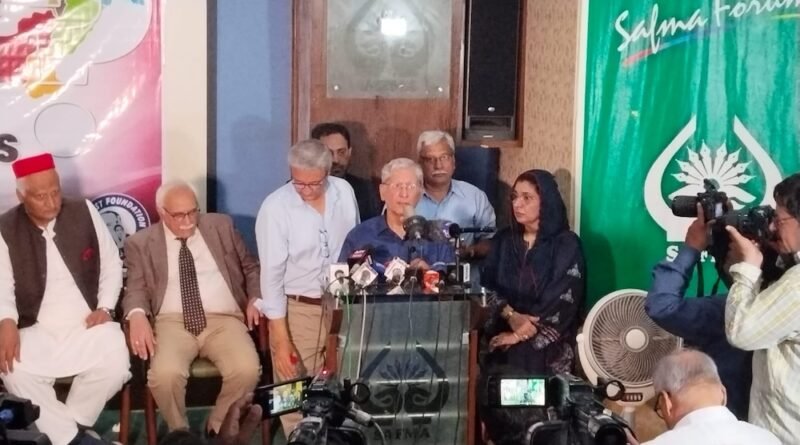
He was speaking as chief guest at a seminar titled “More Provinces or Empowered District Governments”, organised by the Shaheed Bhutto Foundation at the South Asian Free Media Association on Thursday.
Criticising the country’s governance structure, Mr Ahsan said that little had fundamentally changed in the power structure since August 13, 1947, apart from the replacement of the British flag with Pakistan’s national flag.
He argued that much of the administrative machinery established during the British period continued to operate in largely the same manner. He linked the persistence of this centralised governance structure with the country’s continuing political and economic difficulties, noting that Pakistan’s foreign debt had reached around $150 billion.
Mr Ahsan said local governments were essential for effective governance and urged all political parties to hold local government elections regularly. He also called for greater austerity in government spending, saying public resources should be used responsibly.
The seminar brought together politicians, lawyers, journalists and political analysts to discuss whether Pakistan needed additional provinces or stronger district-level governments.
Journalist Imtiaz Alam said the country’s fundamental problem remained an authoritarian system of governance. He cautioned that district-level governance had, at different points in Pakistan’s history, been used by military rulers as a means of weakening elected parliamentary institutions rather than genuinely transferring power to the grassroots.
He also referred to the country’s past political crises, arguing that ignoring the public mandate had contributed to serious political consequences, including the country’s disintegration in 1971.
Speaking about the constitutional and political framework, Shahzad Saeed Cheema said the 1973 Constitution remained the country’s real social contract. He expressed concern that legislative developments after the 18th Amendment were often viewed with suspicion because parliament continued to operate under the influence of powerful unelected institutions.
Other speakers highlighted concerns over restrictions on freedom of expression and the absence of consistent, long-term national policies. They stressed the need for meaningful political dialogue, stronger civilian institutions and greater civilian supremacy to address Pakistan’s governance and economic challenges.
The speakers generally agreed that the debate over creating more provinces should not overshadow the need to strengthen institutions at the district and local levels. They called for genuine devolution of political, administrative and financial authority so that citizens could have a more direct role in governance and access public services closer to their communities.