
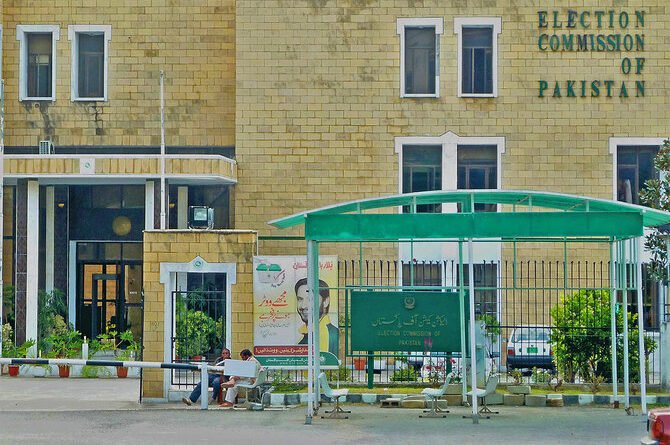
ECP Orders Immediate Election Schedule for Islamabad Local Government Polls
ISLAMABAD: The Election Commission of Pakistan (ECP) on Wednesday directed its office to immediately prepare and issue the election programme for local government polls in the Islamabad Capital Territory (ICT), ruling that the elections would be held under the Islamabad Capital Territory Local Government Act, 2015.
A five-member bench headed by Chief Election Commissioner Sikandar Sultan Raja issued the order while hearing a case concerning repeated delays in holding local government elections in the federal capital. The bench also comprised Nisar Ahmed Durrani, Shah Muhammad Jatoi, Babar Hassan Bharwana and Justice (retd) Ikramullah Khan.
Interior Secretary Ahmed Raza Sarwar and Additional Deputy Commissioner Uzair Ali Khan, representing the Islamabad chief commissioner, appeared before the commission. Senior ECP officials also attended the proceedings.
ECP Special Secretary Zafar Iqbal Malik informed the bench that constituency delimitation had been carried out six times and election schedules had been issued four times, but the polls could not be held. He said the latest delimitation exercise was finalised and published on October 14.
According to Malik, the Islamabad Local Government (Amendment) Ordinance, 2026, expired on September 6. The delimitation process had been undertaken under the ordinance, which proposed replacing the Metropolitan Corporation structure with three town corporations aligned with National Assembly constituencies.
He said the Interior Ministry had been sent two reminder letters regarding the ordinance’s expiry, but the required election rules had not been finalised. The Ministry of Law had also declined to vet the rules, he added.
As the federal government had not enacted replacement legislation before the ordinance lapsed, the ECP decided to proceed under the 2015 law, which remains in force.
The interior secretary acknowledged the facts presented by the commission but argued that reverting to the previous law would require the existing process to be scrapped. Chief Election Commissioner Raja, however, maintained that the earlier delimitation exercise would not be affected by holding elections under the 2015 Act.
Expressing concern over the prolonged delay, Raja remarked that it appeared the government did not wish to hold local government elections in Islamabad. He stressed that the Constitution required elections to be conducted under the applicable local government law.
In its short order, the commission directed its office to issue the election programme without delay in accordance with the ICT Local Government Act, 2015, the Elections Act, 2017, and the relevant rules. It also ordered that all consequential steps be taken expeditiously and in accordance with the law to ensure timely completion of the electoral process.
Islamabad has been without an elected local government since the term of its previous administration expired in February 2021. The capital’s only local government elections were held in 2015, when polling took place in 50 union councils. The PML-N won the elections, and Sheikh Anser Aziz became the city’s first mayor.
Under Article 140-A of the Constitution and Section 219(4) of the Elections Act, 2017, local government elections are required to be held within 120 days of the expiry of a local government’s term. However, repeated changes to the legal framework and the number of union councils have delayed the electoral process.
The number of union councils was initially set at 50, later increased to 101 and subsequently to 125. In December 2022, elections scheduled for December 31 were postponed after the government amended the law shortly before polling to increase the number of union councils.
The ECP later announced a fresh schedule for February 15, 2026, covering 125 union councils. However, the commission withdrew it after the federal government introduced the 2026 amendment ordinance, requiring fresh delimitation under the proposed town corporation structure.
Efforts to enact replacement legislation remained incomplete when the ordinance expired. The ECP has now opted to proceed under the 2015 law, potentially clearing a major legal hurdle to elections that have remained pending for more than five years.