
E-Challan System Fails to Bring Order on Karachi’s Roads Despite Hundreds of Thousands of Tickets
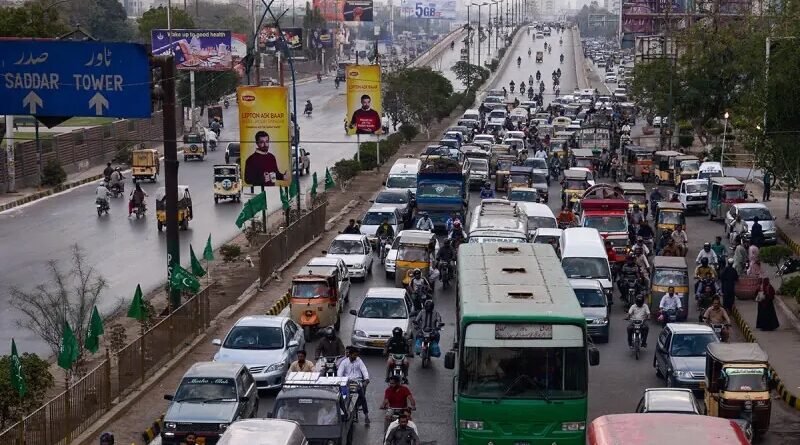
KARACHI – Despite the launch of a faceless e-ticketing system on major corridors in October 2025, compliance with traffic laws remains inconsistent across the city, with chaotic situations still visible on roads where cameras are installed due to dysfunctional signals, fading stop lines, and missing zebra crossings.
According to traffic police data, the total number of e-challans increased every month from January to March — 128,990 in January, 156,099 in February, and 164,033 in March — before declining to 144,437 in April.
However, observations along various main arteries of District East, Central, and South — including Shahrah-i-Noor Jahan to Soldier Bazaar, and Sharea Faisal to Saddar — revealed that motorists and bikers tend to be more cautious on roads where cameras are installed or traffic signals are functioning. This is particularly evident on Sharea Faisal, I.I. Chundrigar Road, Boat Basin, and the PIDC signal.
At various points where the e-challan system has been implemented but traffic signals were non-functional, police officials were manually managing the flow of vehicles. The situation appeared more chaotic at Arts Council Chowk and its adjoining arteries, where both cameras and signals seemed out of order, with vehicles from multiple directions converging at the intersection.
Similarly, on the road from PIDC towards I.I. Chundrigar Road and Pakistan Chowk to Fresco Chowk, despite installed signals and cameras, most were non-functional, leading to disorderly vehicle movement.
It was also observed that during congestion or blockages, vehicles and motorcyclists traveled on the wrong side of the road, and many bikers were seen without helmets — even in the presence of traffic wardens.
While many motorists on Sharea Faisal comply with seat belt regulations, around 30 to 40 percent of bikers still do not wear helmets, despite frequent e-challans and the presence of traffic wardens, especially near Avari Tower.
On routes where cameras and signals are installed but presumed non-functional, and traffic is managed manually, most people follow wardens’ instructions. However, some motorists still take wrong turns, leading to congestion.
Along Shahrah-i-Noor Jahan to Numaish, where signals are not functioning, wardens actively manage traffic. Most commuters follow directions, but most bikers do not wear helmets. Some bikers have also tampered with number plates by using cloth to hide registration numbers.
At night, from Empress Market through the OMI Hospital area, Soldier Bazaar Road, and Aga Khan Jamat Khana to Lasbela Chowk — where cameras are not installed, wardens are mostly absent, and signals are often non-functional — commuters follow rules selectively.
However, on some roads where signals are installed, such as from Women College to the Sindh High Court, commuters generally wait for the signal to turn green even in the absence of traffic police.
DIG Traffic satisfied with police performance
Despite issuing a total of 593,559 e-challans over the last four months, DIG Traffic Pir Mohammed Shah said he was reasonably satisfied with police performance regarding law enforcement.
“There has been a noticeable improvement in both detection and documentation, particularly with the integration of technology,” he told media. “That said, there is always room for greater consistency and refinement.”
He said fluctuations in violation data are not unusual, reflecting factors such as targeted enforcement drives, operational priorities, seasonal traffic patterns, and increased public awareness. In some cases, a rise in violations actually indicates more effective enforcement.
Regarding the perception of greater focus on seatbelt violations compared to wrong-way driving, the DIG clarified that enforcement is being carried out across all major categories. However, certain violations like seatbelt usage are easier to detect through automated systems, making them appear more prominent in data. “Wrong-way driving remains a serious concern and is being addressed through dedicated field deployments and targeted actions,” he said.
As for CCTV coverage, he said it is being expanded beyond the earlier baseline in the second phase, with the number of cameras set to grow by more than 2,000. “The Safe City infrastructure and other surveillance initiatives have significantly enhanced our monitoring capacity, though we are continuing to work towards broader and more integrated coverage across the city,” he added.
According to traffic police data, speeding tickets issued were 5,975 in January, 4,607 in February, 5,555 in March, and 5,471 in April. Tickets for extra lights/decoration were 26 in January, 491 in February, 198 in March, and five in April. Violations for “passenger on rooftop” totaled 266 in January, 203 in February, 373 in March, and 1,095 in April. Fines for improper load were 317 in January, 337 in February, 371 in March, and 324 in April