National Debate Calls for New Provinces and Stronger Local Governments in Pakistan
ISLAMABAD: Political leaders, policymakers, technocrats, and civil society representatives have called for the creation of new provinces, administrative units, and comprehensive local government reforms to address Pakistan’s growing governance challenges and improve public service delivery.
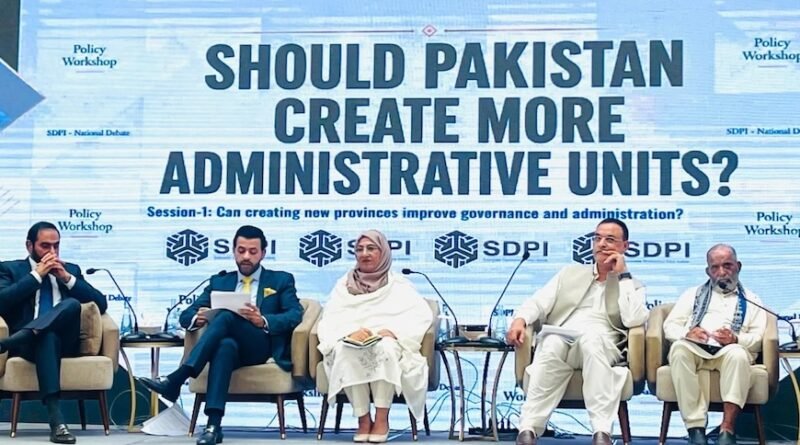
The discussion took place during a national policy dialogue titled “Should Pakistan Create More Administrative Units?”, organized by the Sustainable Development Policy Institute (SDPI). The event brought together senior representatives from PML-N, PPP, PTI, MQM, Jamaat-e-Islami (JI), JUI-F, federal ministers, economists, governance experts, and members of civil society.
Participants explored various governance reform options, including the establishment of new provinces, strengthening local governments, fiscal devolution, institutional reforms, and restructuring administrative systems to better meet citizens’ needs. A broad consensus emerged that any future reforms should be guided by constitutional provisions, public support, fiscal sustainability, administrative capacity, and their impact on service delivery.
Several speakers stressed that political, administrative, and financial powers should be devolved further to enable local institutions to respond more effectively to public needs. While some participants supported the creation of additional provinces and smaller administrative units, others argued that empowering existing provincial, divisional, district, and tehsil-level institutions should remain the priority.
Jamaat-e-Islami leader Liaqat Baloch emphasized that the debate on new provinces should be accompanied by broader constitutional and fiscal reforms. He also called for a more effective role of the Council of Common Interests (CCI)in resolving disputes related to resources, water, and constitutional matters.
Federal Minister for National Health Services Syed Mustafa Kamal said that any administrative restructuring should ultimately be judged by its ability to reduce citizens’ sense of exclusion and improve government service delivery. He maintained that smaller administrative units could bring government closer to the people, while strong local governments would remain an essential part of Pakistan’s governance system regardless of the number of provinces.
Minister of State for Law and Justice Barrister Aqeel Malik highlighted that elected representatives are most frequently approached over local issues such as roads, streets, sewerage, and municipal services, underscoring the importance of effective local governments.
PPP leader Qamar Zaman Kaira cautioned that any restructuring process should be handled carefully to avoid increasing provincial or regional sensitivities over resource distribution. Former MNA Nadeem Afzal Chan called for a consensus-based reform agenda, linking administrative reforms with judicial reforms, electoral reforms, intra-party democracy, and the rule of law.
Former federal minister Asad Umar identified excessive centralization and declining public trust in state institutions as major governance challenges. He proposed a three-tier National Finance Commission (NFC) mechanism to distribute resources among the federal, provincial, and local governments.
PTI Secretary General Salman Akram Raja argued that Pakistan already has divisions, districts, and tehsils that require greater empowerment, noting that even if Punjab were divided into three provinces, each would still have a larger population than many European countries.
Economist Dr. Farrukh Saleem opposed creating numerous new provinces without first addressing institutional weaknesses, arguing that Pakistan’s primary challenge lies in governance and public expenditure rather than tax collection. Senior journalist Mohammad Mallick also stressed that administrative restructuring alone would not succeed without meaningful institutional and political reforms.
Concluding the event, SDPI Executive Director Dr. Abid Qaiyum Suleri said the dialogue highlighted diverse perspectives on governance reforms while reinforcing the importance of strong local governments, fiscal devolution, and improved public service delivery as key pillars of Pakistan’s future governance framework.