Punjab Launches Paperless Governance to Digitize Public Services and Enhance Transparency
LAHORE: Punjab Chief Minister Maryam Nawaz Sharif has officially launched the province’s Paperless Governance initiative, introducing fully digital Government-to-Government (G2G), Government-to-Business (G2B), and Government-to-Citizen (G2C) services as part of an ambitious drive to modernize public administration and improve transparency.
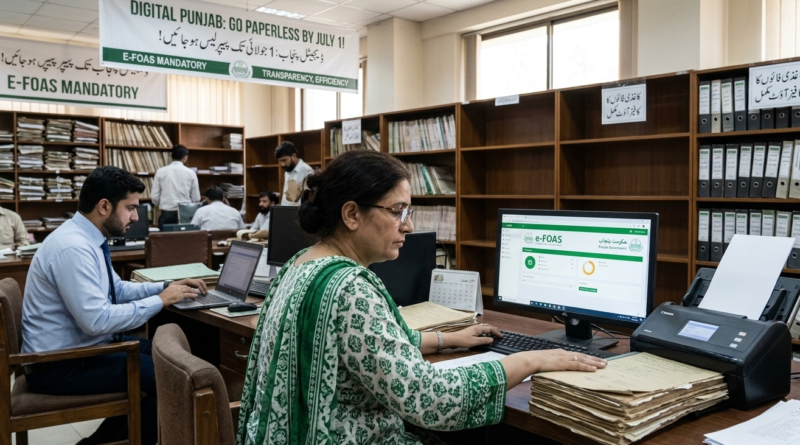
Chairing an online meeting on digitalization and automation, the Chief Minister announced that Punjab has become the first province in Pakistan to establish integrated digital platforms, including e-FOAS, e-Procurement, e-Pay, e-Auction, OneMap, HRMIS, and a centralized Data Warehouse.
Maryam Nawaz directed the Punjab Information Technology Board (PITB) to expedite the import of paperless automation software and establish a continuous public feedback mechanism to further improve service delivery.
She said an end-to-end automated paperless system would play a significant role in eliminating corruption by reducing direct interaction between citizens and government officials. She added that the government aims to spare citizens from making unnecessary visits to government offices, even for minor services, while digital systems that do not require applicants to disclose their identity would further minimize opportunities for corruption.
The Chief Minister reaffirmed that every department, institution, and sector in Punjab is being brought under a comprehensive digital transformation strategy to ensure transparency, efficiency, and better governance.
The meeting was informed that more than 6,000 government systems have already been integrated with the PITB’s central digital platform, while over 600 organizations are now connected through the e-FOAS system. The e-filing platform has processed 176,173 summary notices, resulting in savings of Rs9.1 million.
Officials also reported that smart monitoring of development projects has significantly improved transparency. More than 25,000 suppliers have been connected to the province-wide e-Procurement system, through which digital procurements worth Rs6 trillion and approximately 1.29 million tenders have been processed.
The briefing further revealed that the end-to-end digital tendering system has eliminated the need for physical visits to government offices, generating savings of Rs1.3 million, while digital transactions have produced Rs1.137 billion in government revenue.