Pothole-Ridden Roads and Ongoing Construction Leave Gulistan-e-Jauhar Commuters Struggling
KARACHI: Residents of Gulistan-e-Jauhar continue to endure severe traffic congestion, damaged roads, and prolonged construction work, with commuters urging authorities to accelerate infrastructure projects and restore normal traffic flow in one of Karachi’s largest residential neighborhoods.
Despite being regarded as an upper-middle-income locality that has witnessed significant residential and commercial expansion over the years, several of Gulistan-e-Jauhar’s main roads and internal streets remain in a deteriorated condition. Deep potholes, broken road surfaces, ongoing excavation work, and heavy dust have transformed routine commutes into lengthy and exhausting journeys for thousands of residents.
The situation has been aggravated by the continued construction of the Bus Rapid Transit (BRT) Red Line on University Road, which has caused persistent traffic congestion for several years. As motorists increasingly rely on alternative access routes, they are encountering similar challenges due to road rehabilitation and utility installation works.
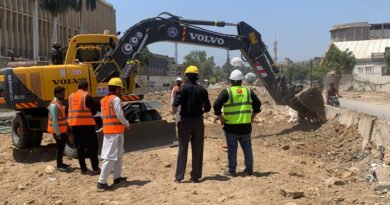
One of the worst-affected routes is Pehlwan Goth Road, a major access corridor connecting Gulistan-e-Jauhar with Shahrah-e-Faisal and Jinnah International Airport. What was once a 10-minute drive now frequently takes between 30 and 40 minutes during peak hours. A large section of the dual carriageway has been excavated for sewerage and water pipeline installation, significantly reducing road width. Near the local graveyard, the road narrows to a single usable lane, creating bottlenecks and slowing traffic.
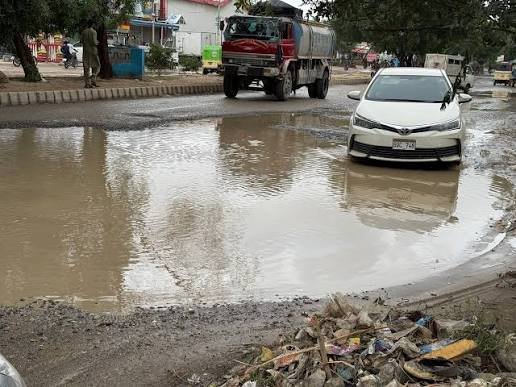
Further ahead, motorists encounter severely damaged pavement, deep potholes, stagnant rainwater, and muddy sections that force vehicles to crawl at extremely low speeds. Near the PSO filling station, one portion of the road has become almost impassable due to a combination of excavation work, large potholes, and accumulated water.
Motorcyclists say hidden potholes beneath rainwater have become a serious safety hazard, particularly at night. Several commuters reported narrowly avoiding accidents after their motorcycles suddenly struck submerged potholes. Rickshaw drivers also face difficulty navigating the damaged sections, often taking several minutes to cross short stretches while carefully avoiding deep craters.
Another major access route, Johar Chowrangi Road, has also deteriorated because of the ongoing construction around the Munawar Chowrangi Underpass. The stretch between Darul Sehat Hospital and Afnan Duplex is riddled with uneven surfaces and broken pavement, forcing motorists to reduce speed significantly. Nevertheless, commuters continue using the route because University Road remains heavily congested.
The poor infrastructure extends beyond the main arteries into the neighborhood’s internal road network. Streets across Blocks 1, 2, 3, and 3-A—including Ibrahim Street, Hill Top Street, Siddiqui Street, and roads surrounding Steep Hill Drive and Anwar-i-Attar Mosque—are marked by potholes, cracked surfaces, and uneven carriageways that make even short-distance travel slow and uncomfortable.
Apart from damaged roads, commuters also face constant exposure to dust generated by ongoing construction activities and deteriorating road surfaces. While occupants of private vehicles enjoy some protection, motorcyclists and rickshaw passengers are left covered in dust within minutes, raising concerns about respiratory health and overall commuter safety.
Residents acknowledge that repair work has finally begun on some roads but say progress remains far too slow. They have urged the Karachi Metropolitan Corporation and other relevant authorities to expedite rehabilitation work on Pehlwan Goth Road, Johar Chowrangi, Munawar Chowrangi, Kamran Chowrangi, and surrounding streets to minimize disruption for thousands of daily commuters.
Residents stressed that timely completion of these infrastructure projects is essential to restore smooth traffic flow, improve road safety, and provide much-needed relief to people who have been facing travel difficulties for years.